• I have been thinking about grammar in Sacred Scripture.  Well, why not?  We think about vocabulary when we think about the Bible. We ask what this word means and that word means.  We think about manuscripts, because there are thousands of variant readings in the Bible, and different manuscripts which people have made over the centuries have different readings.  So why not think about grammar too?

    In John’s Gospel (1:38-39), two of the disciples of John the Baptist come to Jesus, and he asks them a question: “What do you seek?”  It’s in the interrogative mood, and it really anticipates a reply in the indicative mood: “We are trying to find out more about you”, or some such thing. Instead, they answer with a question: “Rabbi, where are you staying?”  Now it is they who speak in the interrogative mood, asking a question. Now they are looking for information, so the natural response to that would again be in the indicative: “I’m staying in Bethany [the one on the east side of the Jordan, not the Bethany by the Mount of Olives], in a house on the main street, three doors along from the butcher’s shop” – or some such thing.

    But now Jesus answers, not in the indicative, nor in the interrogative mood, but in the imperative: “Come and see.” He utters a command.

    These two disciples are looking for information. Jesus will not give it to them. Instead he calls them to a change in practise, to a way of living: come and see.  Our encounter will begin not with information, but with a practice and corresponding experience: come and see. Walk this way.

    This touches on one of the themes of God as Nothing. Over and over again, the book stresses the view of Thomas Aquinas, and of many other great teachers of the Christian tradition, that we cannot know what God is.  To know God, Thomas says, is to know that we don’t know what he is.  Knowing God is not about gathering information – and it cannot be, as there is no information about God to be had.

    Even what might look like information about God is actually nothing of the sort.  Of course, Thomas wants to say all kinds of things about God, but he insists that these don’t actually tell us what God is like.  They might be metaphors (God is a rock, God is a warrior, God is a mother hen), or they might be analogies (God is good, or God is beautiful – though we cannot know what these things mean when they are applied to God).  The most accurate things we can say about God are negative things, or Thomas: God is not this, and not that.

    But whatever we say about God, Thomas says, even when they are true things, they do not give us information about God as he is in himself.  They rather give information about his creatures in so far as they relate to God.  This is a bit difficult. Let us put it this way: for Thomas, it is true to say that ‘God is the Creator’, but when we say it we are not expressing accurate information about God. We are expressing accurate information about ourselves: we really are created.  It is a fact about us that we are creatures.  It is therefore logically true that God created us, but that is not information about what God is like, because being a creator is not what God is like.  If it were, then God would have changed from not-being-a-creator before the act of creation to being-a-creator after the act of creation. And of course God cannot change.  And also there can be no such thing as ‘before creation’, because time itself is part of creation.

    This is why Thomas says that calling God ‘the Creator’ does not actually tell us what God is. It is merely a logically necessary expression implied by the fact that we are creatures.

    If God were a being, an individual of some sort, there would be various descriptive things we could say about him more or less accurately, about what he was like. Throughout God as Nothing, however, we deny this possibility.  Where the mind quite understandably asks for information, for a description, it cannot find it. What it finds instead is a calling: come and see. An invitation to change your life.

    We long to know God, and we do, in Christ.  But not through information offered in the indicative mood.  We know God by responding to his call in the imperative.

    Of course we want to know God. And Jeremiah reminds us that knowing God is not about gathering information at all:

    “Did not your father have food and drink?

    He did what was right and just,

    so all went well with him.

    He defended the cause of the poor and needy,

    and so all went well.

    Is that not what it means to know me?”

    declares the Lord.  (22:15-16).

    This blog was created to encourage discussion and engagement
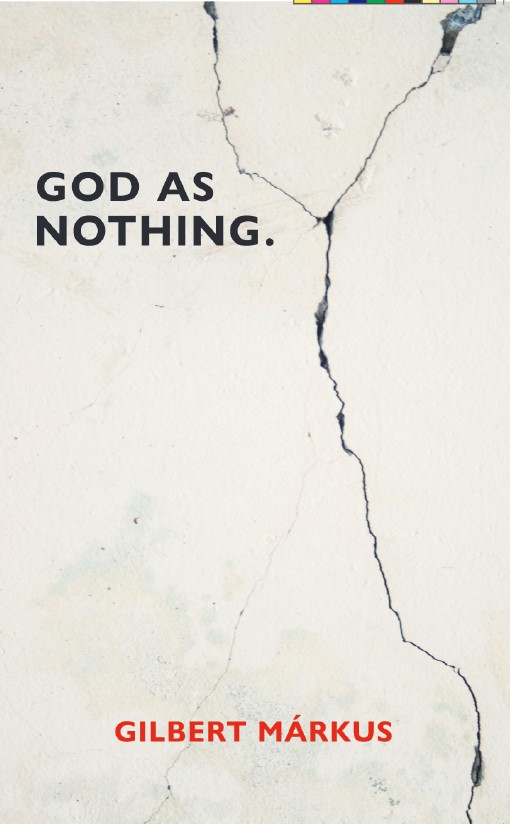
    with the recently published book God as Nothing, by Gilbert Márkus.
    You can order a discounted copy from Writing Scotland here.

  • This little thought is something I wrote for the Substack of my publisher, Darton, Longman & Todd. I share it here….

    Most of the people I love are actually atheists. That’s how they see themselves. Family, friends, colleagues, comrades in politics – they will often say, with firm conviction, ‘I don’t believe in God.’ And then I might ask them, ‘What God is it that you don’t believe in?’ And they will go on to give an account of some being – a powerful and invisible individual who dwells ‘up there’ or ‘somewhere’, one who makes demands, who rewards and punishes, who sometimes intervenes in the world, and they will say, ‘That’s what I don’t believe in.’ And I will typically respond by saying, ‘Well I don’t believe in any such being either.’ Of course I might use images, language, pictures, that suggest that kind of thing if you take them literally. But I don’t actually believe in such a being. Because at the root of our monotheistic tradition is this question about the world: ‘Why does anything exist, rather than nothing?’ The answer to that question cannot be any kind of ‘something’, obviously, because that would itself be just one of the ‘somethings’, part of the ‘everything’, that we are trying to explain.

    Once we have understood this ancient Jewish and Christian idea, that God is not any kind of being, that God is (as Thomas Aquinas said) ‘utterly beyond the order of beings’, then we can be free of the pictures. We still use such pictures, of course, whenever we speak, but we know that they are not ‘what God is like’. There is, and can be, no such things as ‘a description of what God is like’, because (as Thomas Aquinas said once again), ‘To know God is to know that we don’t know what he is.’

    In many ways, then, the atheist is the believer’s ally. The atheist says that there is no such individual entity as what he imagines we mean by ‘God’. And our answer is not that there is such an entity; our answer is, ‘We are not describing any kind of being. Thank you for reminding us that no individual being can be God.’

    Atheism is a kind of ally to belief, then, rescuing us from taking our pictures too literally. But there is in fact a real and bitter opponent of faith. It is not atheism, but is idolatry. The opposite of belief in the God who is the lover and creator of all that exists (and is therefore not one of the things which exist) – the opposite of that is the worship of some existing thing. Some object that exists. Some being who we are supposed to find more important than our neighbour, and to whom we give absolute obedience, even at the expense of other people. It is that ‘being’ which is the opposite of faith.

    If God and a person are not ‘two beings’ or ‘two individuals’, we can never choose between loving one and loving the other. They cannot be two alternative objects of love. God is not one of anything.

    But hear what Augustine has to say about this. He is wondering what it can possibly mean to love God, and he turns to the First Letter of John:

    “If someone loves their neighbour, it follows that they must above all love love itself. But ‘God is love, and whoever abides in love abides in God.’ … Let no one say, ‘I don’t know what to love.’ Let him love his brother and let him also love that love itself. … Let us observe how much the apostle John commends brotherly love: ‘Whoever loves his brother,’ he says, ‘remains in the light, and there is no scandal in him.’ … He seems to be silent about the love of God, but he would never do this unless he wanted God to be understood in terms of brotherly love. And he says it most clearly a little later in the same letter: ‘Beloved, let us love one another, for love is from God, and every one who loves is born of God and knows God. Whoever does not love does not know God, for God is love.’ This passage clearly and sufficiently declares how this brotherly love is proclaimed on the highest authority not only to be from God, but actually to be God” (De Trinitate VIII, 10, 12).

    For Augustine God is not an object of our love among other objects. God is the love itself. It is the love, as Dante says, ‘which moves the sun and other stars’. We don’t love some object when we love God. We love the love with which we love one another.

    So all you people I have loved, and whom I will love in the future, who call yourselves atheists – people who have loved me back, people who love one another, who love the poor, the excluded and the powerless, who love your neighbours and even your enemies – that is enough for me. As ‘atheists’ you deny that any individual being is God. So do I. You will give divine honour to nothing. Me too. But by the very fact of your love, you show that you love love. And love is the name of God. It is partly for you that I wrote this book, God as Nothing. Because I, a believer, believe in the Nothing which is another name for God.

    This blog was created to encourage discussion and engagement
    with the recently published God as Nothing, by Gilbert Márkus.
    You can order a discounted copy from Writing Scotland here.
  • ‘A picture held us captive.
    And we could not get outside it,
    for it lay in our language
    and language seemed to repeat it to us
                                                    inexorably.’

                            (L. Wittgenstein, Philosophical Investigations §115)

    When we first learned our native language, our ‘mother-tongue’, most of us learned nouns first, later progressing to verbs, prepositions, adjectives and the rest. We lived in a world of things, and the most basic linguistic task of attaching verbal labels to things – Mummy, Daddy, doggy, socks – is probably the easiest to learn. Verbs come later, having more complex concepts behind them, requiring a subject for example: “I am hungry.” or “Billy has stolen my sandwich.”

    Food arrives at the Mercy Convent, Edinburgh,
    for the meal cooked nightly for homeless people

    The world of things (what theologians and others like to call ‘Creation’), still dominates our language, and therefore still pervades our ways of talking about God. It makes us think of God as one of the things which exist, as we use nouns( a judge, a warrior, a redeemer, a friend, a leader, a rock) or pronouns (he, she) to refer to him.  And these nouns are the ‘picture that held us captive’. We talk about God, or to God, as to an individual being, because that is the way our language works, which we learned in the world of things.

    But even if Wittgenstein is right, and we can’t get outside the picture, because we can’t get outside the language, we can still remind ourselves that it is ‘only a picture’.

    If God is the creator of all that exists, visible and invisible as we sing in the Creed, then he is not one of the things that exist. And even though we use nouns and pronouns for ‘him’, we therefore know that these can’t be labels that we have attached to some individual thing or being. It is better, as Thomas Aquinas suggests, to think of God as a verb, not a noun. God is, for Thomas, simple esse, which means ‘to be’. Not ‘a being’ (that’s a kind of something), but ‘to be’ – the infinitive form of the verb.  The esse which is the origin of all existence, of all existing things.

    Now if God is not any kind of thing, not an existing object of any kind, then it makes no sense to ask, ‘Am I worshipping the right God?’  It is a meaningless question, because it starts from the assumption that ‘God’ is the name of an individual.  It assumes that ‘God’ identifies one object in the world, out of all the other possible objects, and says ‘This is the one that we worship.’  But God is not one of the objects in the world.  So you can’t worship ‘the right God’ – or ‘the wrong God’ for that matter.

    So what is the question we need to ask ourselves about the worship of God, about the love of God, about faith in God?

    It is not about finding ‘the right object’.  It is about living the right way with one another, with other individual people and communities – who really are objects in the world.

    The truth of our approach to God is not in the identification of the right individual in heaven, but in the love we show to individuals on earth. And so the movement for Justice and Peace lies at the very heart of our faith.  It is not a consequence of our finding ‘the right God’ and then doing what that God tells us.  It is the very foundation of our finding God at all.  It is what makes our lives a dynamic sharing, by his grace and love poured into our hearts, in the life of God, in the very nature of God – how we become divine.

    This blog was created to encourage discussion and engagement
    with the recently published God as Nothing, by Gilbert Márkus.
    You can order a discounted copy from Writing Scotland here.
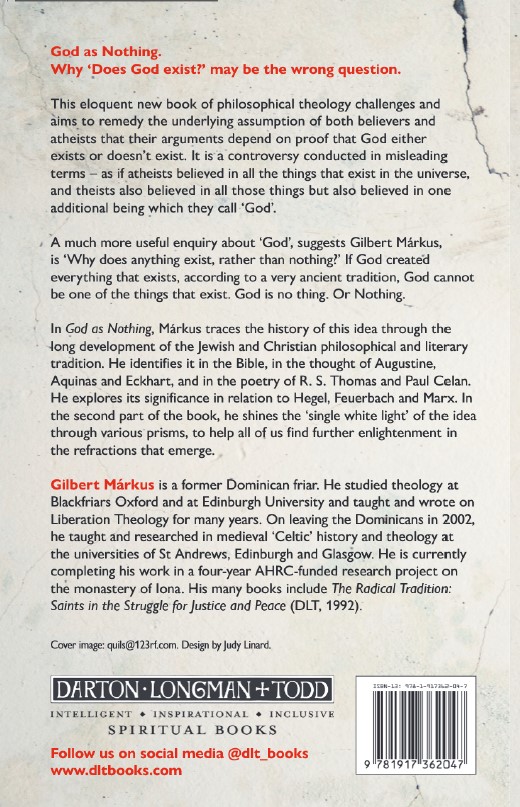
  • I’m very pleased to announce today the publication of the book, God as Nothing. For forty years I have been turning this one thought over and over in my mind. I wrote about it in my undergraduate dissertation in 1985, taught about it at Edinburgh University, and spent countless very enjoyable evenings discussing it with friends. London publisher Darton, Longman and Todd (with whom I have published in the past) have done a very nice job of making it into a book. It is available HERE from Writing Scotland at a significant discount – only £12 for UK customers (including postage), and a bit more (but still very reasonable) for overseas customers.


  • One of the things that constantly draws me back to thinking about this idea of God as Nothing is the frustration of listening to so many conversations between ‘believers’ and ‘atheists’, each side digging into their respective positions, mutually uncomprehending, often mocking each other, or expressing concern for one another’s sanity or intelligence.

    Because it is a pointless argument.  And it’s not only pointless because no one I know has ever been argued into (or out of) belief in ‘the existence of God’.   It’s pointless because the very term – ‘the existence of God’ – is pretty much meaningless.

    What does it mean to say of something that ‘it exists’?

    Well, let’s think how that works in ordinary everyday human language.  Say I want to persuade you that unicorns exist.  First of all we both have to know what the word ‘unicorn’ means – let’s say it’s the name of a large horse-like creature with a single horn on its forehead.  Without knowing what it is, you can’t make any sense of my claim when I declare to you with my ‘sincere face’ on that, “Yes, unicorns really do exist.”

    Not only do we both have to know what the word ‘unicorn’ means.  If I can’t actually show you one in real life, we’ll have to agree on what would count as evidence of unicorns’ existence.  Imagine….. hoof-prints in the ground, marks on a tree where a horn (a single horn) has been rubbed against the bark, the testimony of a reliable eye-witness.  But the evidence would have to bear some relationship to the thing that we know a unicorn is.  It would be no good my pointing to a bottle of whisky and declaiming, “See! Unicorns do exist.”  Because there is no intelligble connection (unless I can invent one) between that bottle on my desk and the presence or absence of one-horned equine quadrupeds.

    That is how the statement “X exists” works.  And note that to say “X exists” is to offer a description of the world.  The world is just a whole lot of existing things.

    But to say “God exists” is not like that, for several reasons.

    First, it is fundamental to Christian belief that God is a mystery.  We do not know what God is.  We know what a unicorn is – or would be, if it existed.  But we do not know what God is.  As Thomas Aquinas said:  The very nature of God, as he is in himself, neither the Catholic nor the pagan knows (ipsam naturam Dei prout in se est, neque Catholicus neque paganus cognoscit: Summa Theologiae 1a, 13, x).  Even though we are joined to God by grace, in prayer and faith and love and good works, being conformed to him, Thomas says ‘We are joined to him as to the unknown’ (ei quasi ignoto coniungamur: ST 1a, 12, xiii).  So, at the very outset, the discussion of ‘does God exist?’ simply fails to get off the ground.  Imagine a conversation:

                “X exists.”
                “OK. What is this X?”
                “Erm … I don’t know.”

    Secondly, the question of evidence.  What counts as evidence of God existing?  We have imagined what the evidence for unicorns existing might be – hoof marks, horn-scraping, etc – but what would be the evidence for God’s existence, given that we don’t know what God is?  The believer points to the world and says, “The evidence is all this. God made it all.”  But that merely asserts her conviction that the world is created.  It isn’t what we would call evidence – certainly not the kind of evidence that might persuade an atheist.

    But it is just this looking at the world that gives rise to a question: Why is there a world? Why is there anything rather than nothing?  The answer to the question, ‘Why is there anything?’ simply cannot be the name of a ‘something’, an existing entity.  Because such a ‘something’ would be part of the world of existing entities that we are trying to explain.

    The question of God is not really about existence or non-existence.  But it is about how we look at the world of existing things.  They exist, and we may be amazed, filled with awe, touched by a deep – perhaps almost vertiginous – sense of mystery. And here “God” is the name of that mystery. Not the name of a being which might exist or might not exist; but the word we use for the unspeakable, unknowable depth of all the things which do exist.

    This blog was created to encourage discussion and engagement
    with the recently published God as Nothing, by Gilbert Márkus.
    You can order a discounted copy from Writing Scotland here.

God as Nothing

exploring an ancient theme in the Judaeo-Christian tradition: If 'God' is the answer to the question "Why does anything exist, rather than nothing?", then the word 'God' cannot be the name of something that exists. This exploration accompanies the publication of a book, God as Nothing, available at a discount from Writing Scotland here: https://www.abebooks.co.uk/God-Nothing-Why-exist-wrong-question/32191591728/bd