‘A picture held us captive.
And we could not get outside it,
for it lay in our language
and language seemed to repeat it to us
inexorably.’
(L. Wittgenstein, Philosophical Investigations §115)
When we first learned our native language, our ‘mother-tongue’, most of us learned nouns first, later progressing to verbs, prepositions, adjectives and the rest. We lived in a world of things, and the most basic linguistic task of attaching verbal labels to things – Mummy, Daddy, doggy, socks – is probably the easiest to learn. Verbs come later, having more complex concepts behind them, requiring a subject for example: “I am hungry.” or “Billy has stolen my sandwich.”
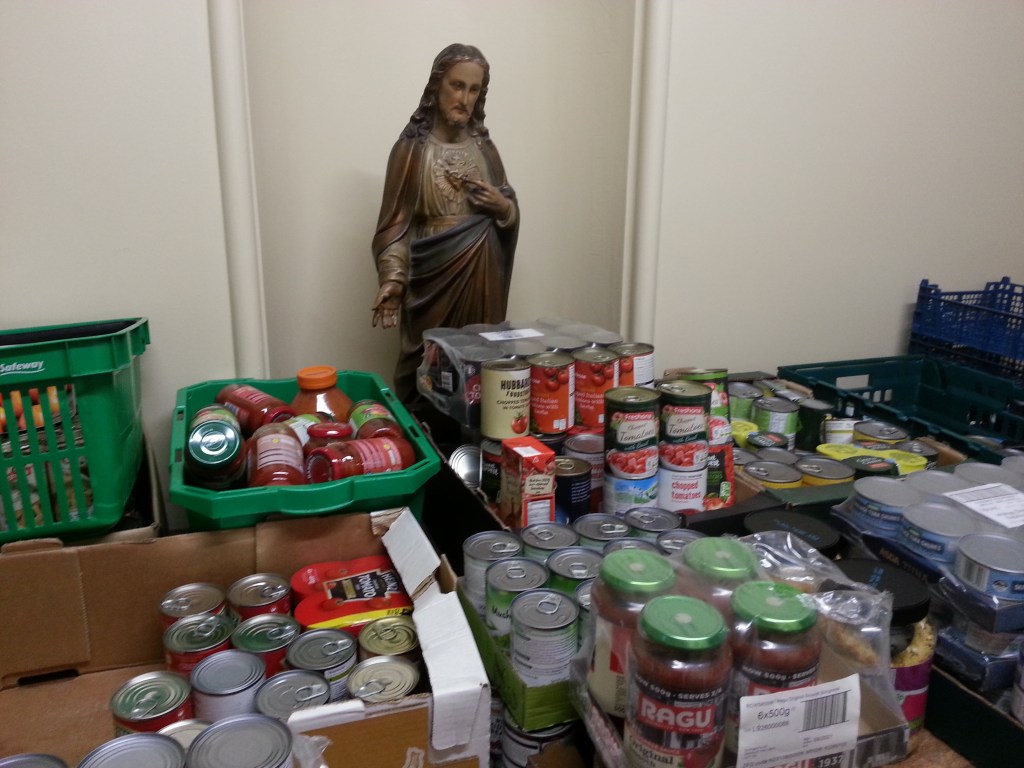
for the meal cooked nightly for homeless people
The world of things (what theologians and others like to call ‘Creation’), still dominates our language, and therefore still pervades our ways of talking about God. It makes us think of God as one of the things which exist, as we use nouns( a judge, a warrior, a redeemer, a friend, a leader, a rock) or pronouns (he, she) to refer to him. And these nouns are the ‘picture that held us captive’. We talk about God, or to God, as to an individual being, because that is the way our language works, which we learned in the world of things.
But even if Wittgenstein is right, and we can’t get outside the picture, because we can’t get outside the language, we can still remind ourselves that it is ‘only a picture’.
If God is the creator of all that exists, visible and invisible as we sing in the Creed, then he is not one of the things that exist. And even though we use nouns and pronouns for ‘him’, we therefore know that these can’t be labels that we have attached to some individual thing or being. It is better, as Thomas Aquinas suggests, to think of God as a verb, not a noun. God is, for Thomas, simple esse, which means ‘to be’. Not ‘a being’ (that’s a kind of something), but ‘to be’ – the infinitive form of the verb. The esse which is the origin of all existence, of all existing things.
Now if God is not any kind of thing, not an existing object of any kind, then it makes no sense to ask, ‘Am I worshipping the right God?’ It is a meaningless question, because it starts from the assumption that ‘God’ is the name of an individual. It assumes that ‘God’ identifies one object in the world, out of all the other possible objects, and says ‘This is the one that we worship.’ But God is not one of the objects in the world. So you can’t worship ‘the right God’ – or ‘the wrong God’ for that matter.
So what is the question we need to ask ourselves about the worship of God, about the love of God, about faith in God?
It is not about finding ‘the right object’. It is about living the right way with one another, with other individual people and communities – who really are objects in the world.
The truth of our approach to God is not in the identification of the right individual in heaven, but in the love we show to individuals on earth. And so the movement for Justice and Peace lies at the very heart of our faith. It is not a consequence of our finding ‘the right God’ and then doing what that God tells us. It is the very foundation of our finding God at all. It is what makes our lives a dynamic sharing, by his grace and love poured into our hearts, in the life of God, in the very nature of God – how we become divine.
This blog was created to encourage discussion and engagement
with the recently published God as Nothing, by Gilbert Márkus.
You can order a discounted copy from Writing Scotland here.
 God as Nothing
Leave a comment